
The Facts and Stats You Need to Know About Fraud
Who is at Risk of Fraud?
The answer is simple: everyone is at risk of fraud. Your job, your age, where you live, how much money you have; neither of these things will make you completely risk-free of falling victim to fraud. We’re not trying to scare you, though. In fact, it’s important to understand that you (yes, you) can fall victim to fraud, because that knowledge is the first step in staying safe.
Since knowledge is so important, we’ve taken some of the most important facts and statistics from the FBI’s Internet Crime Complaint Center’s (IC3) Internet Crime Report, which reports on all the data related to cybercrime and cyber-related crime, which you can view by clicking here.
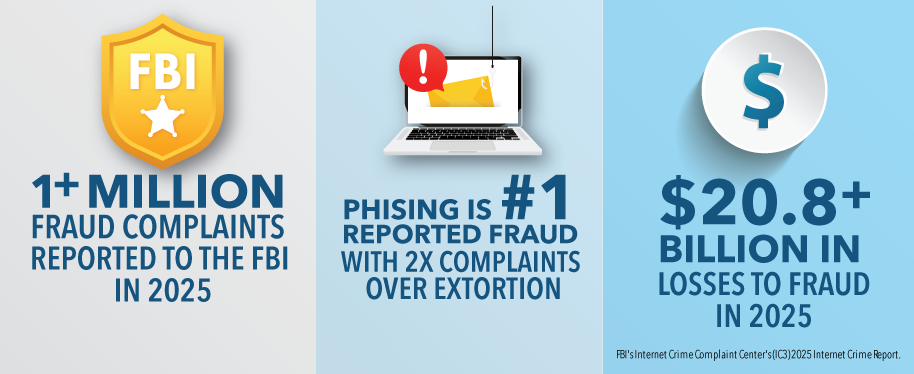
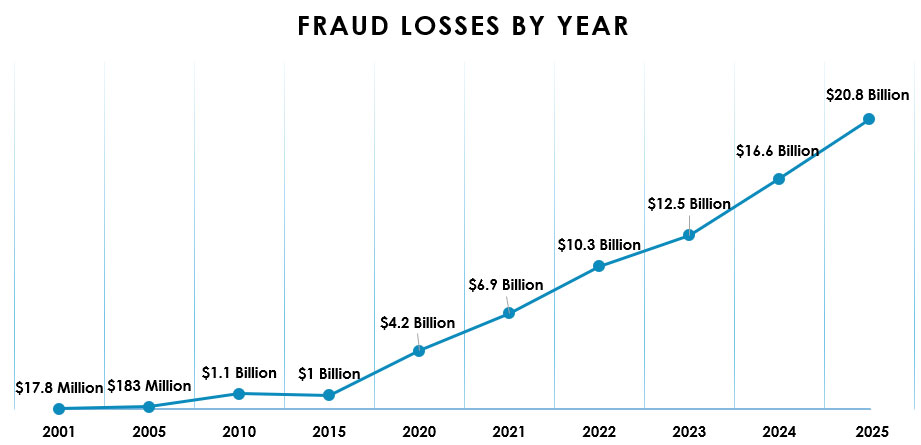
- In 2025, IC3 tracked over 1 million fraud complaints resulting in over $20.8 billion in losses
- Phishing is the #1 reported fraud type with over 191,500 complaints. That’s over double the amount of the second most-reported fraud type, extortion.
- Investment fraud resulted in over $8.6 billion in losses in 2025, significantly higher than any other fraud type.
- 24.2% of all fraud complaints were from individuals 60 years and older, higher than any other age range.
- Washington, D.C., Maryland, and Virginia are all ranked in the top 20 of fraud complaints and losses per 100,000 citizens.
- AI enabled and assisted fraud resulted in over $890 million in losses which is projected to significantly increase in the coming years.
- Cryptocurrency continues to be the preferred method of payment in reported fraud complaints and losses.
Source: Federal Bureau of Investigation’s Internet Crime Complaint Center’s 2025 Internet Crime Report
As mentioned above, fraudsters don’t discriminate by age. In 2025, complaints were filed from individuals ranging from 17 and younger to 60 and older. There is a distinct trend in the data though: the older you get, the more likely you are to fall victim to fraud and lose more money in doing so. Check out the data:
- Individuals under 20 filed over 30,000 fraud complaints resulting in over $67 million in losses
- Individuals between 20-29 years old filed over 112,000 fraud complaints resulting in over $563 million in losses
- Individuals between 30-39 years old filed over 153,000 fraud complaints resulting in over $1.7 billion in losses
- Individuals between 40-49 years old filed over 167,000 fraud complaints resulting in over $2.9 billion in losses
- Individuals between 50-59 years old filed over 124,000 fraud complaints resulting in over $3.6 billion in losses
- Individuals 60 years and older filed over 201,000 fraud complaints resulting in over $7.7 billion in losses
Fraud Incidences in VA, MD, and DC
The DC Metro Area has a ton of great advantages for individuals and businesses alike. This also makes it a prime target for fraudsters. In fact, Virginia, Maryland, and Washington, D.C. are all ranked in the top 20 when it comes to fraud complaints and losses per 100,000 citizens. The table below has more:
| State | Losses per 100,000 population | Rank | Total losses in 2025 |
| D.C. | $14,037,165 | 1 | $97,368,097 |
| Maryland | $6,228,591 | 9 | $390,242,821 |
| Virginia | $5,361,647 | 20 | $467,120,025 |
Important Fraud Questions and Answers
What can I do to avoid fraud?
The numbers can be scary, but there’s plenty you can do to avoid falling victim to fraud. In fact, we have a dedicated Fraud Prevention Security Center, which has information about different types of fraud and how to avoid falling victim to them. We highly recommend you check it out because knowledge is one of the best defenses against the ever-growing wave of fraud.
What should I do if I fall victim to fraud?
Report it! The FBI and IC3 both have places to report fraud on their respective websites. You should also report it to your financial institution, especially if your credit card or other financial or identifying information were stolen or manipulated away from you.
With fraud constantly on the rise, should I just not trust anybody?
No. We don’t recommend going off the grid or becoming a complete shut-in. You can avoid fraud and still live your life to the fullest. It’s important to stay cautious when something feels off or out of place and it’s vital to stay up to date on fraud trends and data, which you’re doing right now by reading this!
How does John Marshall Bank protect my finances from fraud?
We employ a variety of tools and products that protect your hard-earned finances. From notification tools like email and text alerts to account control and security measures like card controls to payment protection like positive pay, and so much more. We also have a full team of experts analyzing any suspicious activity and rapidly responding to any fraud report. When you bank with JMB, you get a strong and capable partner in your corner in the fight against fraud.